

IN SHORT
Spaced repetition means not cramming material in one go, but reviewing it several times with growing gaps. You come back when you have almost forgotten part of it. That way you remember it longer than with the same study time spent in a single day. How big the gaps should be depends on how far away the exam is.
Key takeaways

Why spacing beats cramming
What you learn, you first forget quickly and then more slowly. Hermann Ebbinghaus already showed this in the 19th century. Every review slows the forgetting down. If you bring the material back just before you forget it, it lasts longer afterwards. This is called the spacing effect.
A review of more than 300 experiments confirms it: spaced learning beats learning in one block almost every time (Cepeda and colleagues, 2006).
How long should the gaps be?
A large study with more than 1,350 participants measured this precisely (Cepeda and colleagues, 2008). The result: the best gap depends on when you need the knowledge.
| Exam in … | First review after … |
|---|---|
| 1 week | 1–3 days |
| just over 1 month | about 10 days |
| 2–3 months | about 3 weeks |
How to build a spaced repetition schedule
- 1Set the exam date.
That determines how big the gaps can be.
- 2Retrieve on day one.
Right after learning, answer a few questions on it.
- 3Schedule the reviews.
Two to three dates per topic, with growing gaps.
- 4Review mistakes sooner.
What you didn't know comes first next time.
- 5A little every day.
Better 20 minutes of review every day than three hours once a week.
The most common mistakes
How Learngine does it
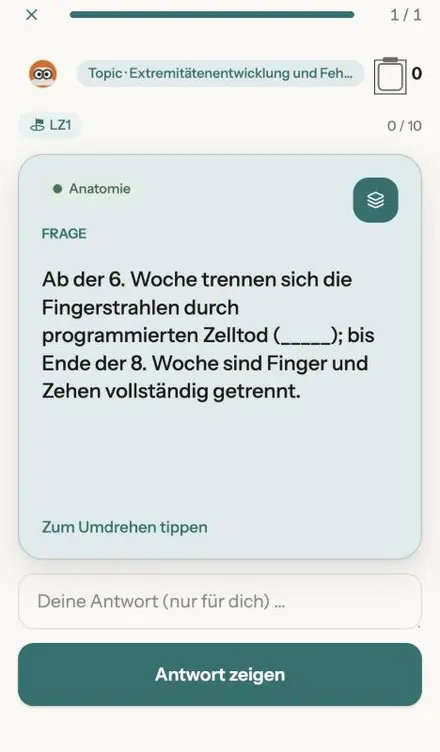
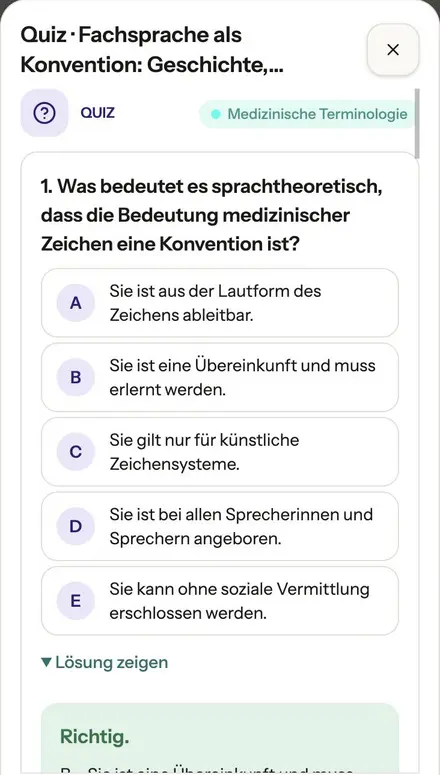
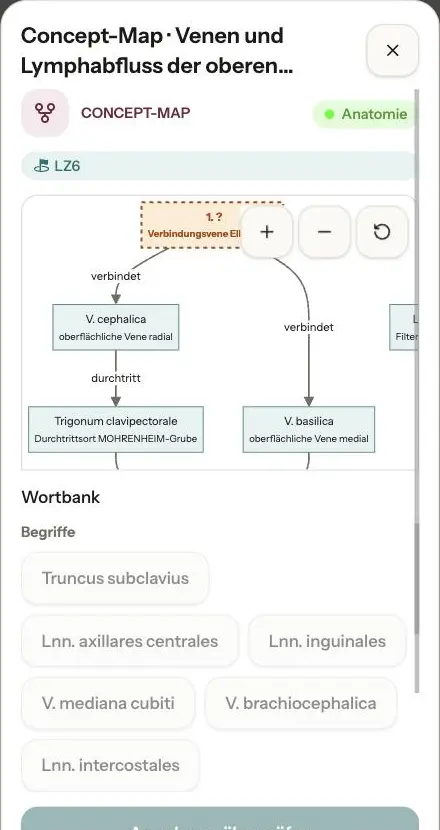
You enter your exam dates. Learngine spreads exercises and reviews so that every topic comes up several times in time and the next exam gets the biggest share. Every day, Lumi tells you what's up next in 10, 25 or 40 minutes. If you miss a day, Lumi replans.


Frequently asked questions
Is spaced repetition the same as the Leitner system?
The Leitner system is one form of it: flashcards move into boxes that are reviewed less often once you know them. Apps do the same automatically. More in how to make flashcards.
Does spaced repetition still help shortly before an exam?
Yes, with smaller gaps. If the exam is a week away, review after one to three days. Starting earlier is better, though.
How many reviews does a topic need?
At least three: learn it, retrieve it after a few days, retrieve it again shortly before the exam. Difficult topics more often.
Show sources (4)
- Cepeda, N. J., Pashler, H., Vul, E., Wixted, J. T. & Rohrer, D. (2006): Distributed practice in verbal recall tasks: A review and quantitative synthesis. Psychological Bulletin, 132(3), 354–380. PubMed
- Cepeda, N. J., Vul, E., Rohrer, D., Wixted, J. T. & Pashler, H. (2008): Spacing Effects in Learning: A Temporal Ridgeline of Optimal Retention. Psychological Science, 19(11), 1095–1102. PubMed
- Kornell, N. (2009): Optimising learning using flashcards: Spacing is more effective than cramming. Applied Cognitive Psychology, 23(9), 1297–1317. Article
- Carpenter, S. K., Pan, S. C. & Butler, A. C. (2022): The science of effective learning with spacing and retrieval practice. Nature Reviews Psychology, 1, 496–511. Article