

IN SHORT
To make flashcards that work, put one clear question on the front and a short answer on the back. One idea per card, in your own words. How you study matters more than how pretty the cards are: answer from memory before you flip, and review the cards with growing gaps.
Key takeaways

Why flashcards work
Flashcards make you pull knowledge out of memory. That retrieval is what strengthens it, more than rereading does. More on this in our guide to active recall.
Spacing helps too: going through one big deck instead of splitting it into many small decks means you see each card less often in a row, and you remember more (Kornell, 2009).
7 rules for effective flashcards
- 1One idea per card.
Three short cards beat one card with a list.
- 2A real question on the front.
"What does the mitochondrion do?" instead of "Mitochondrion".
- 3A short answer on the back.
One sentence or one term. Anything longer belongs on several cards.
- 4Your own words.
Copying slide text is reading. Rephrasing is already learning.
- 5Ask why, too.
Not just definitions: connections and examples as well.
- 6Use images.
A diagram on the front, "What does arrow 3 show?", the answer on the back.
- 7Exam-relevant only.
If it never came up in a past paper, it rarely needs a card.
"Krebs cycle"
"Where in the cell does the Krebs cycle take place?"
A whole slide on one card
Three cards with one question each
Definition copied
Definition in your own words
Terms only
Terms plus "Why?" and "What happens if …?"
Paper or app?
Both work if you retrieve and review with gaps. The difference is effort.
| Paper | App | |
|---|---|---|
| Writing | slow, but you learn while writing | faster, almost effortless with AI |
| Scheduling reviews | yourself, e.g. with a Leitner box | automatic |
| Images and formulas | easy by hand | depends on the app |
| On the go | carry the deck | on your phone |
The most common mistakes
How Learngine does it
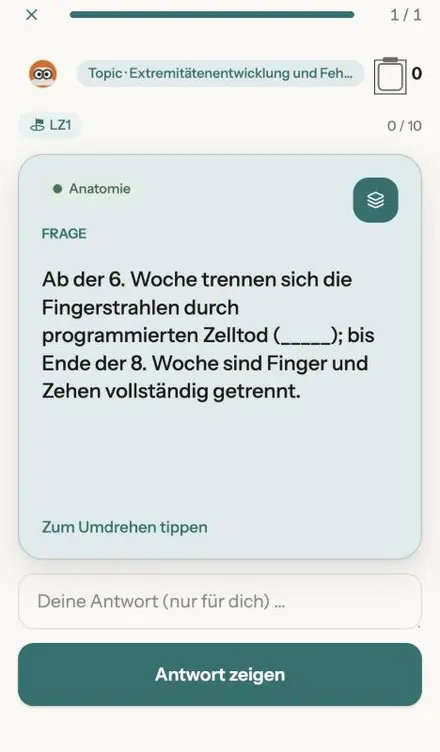
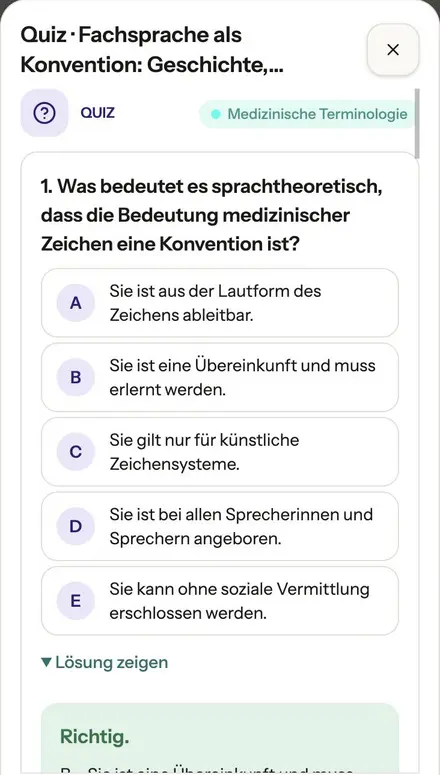
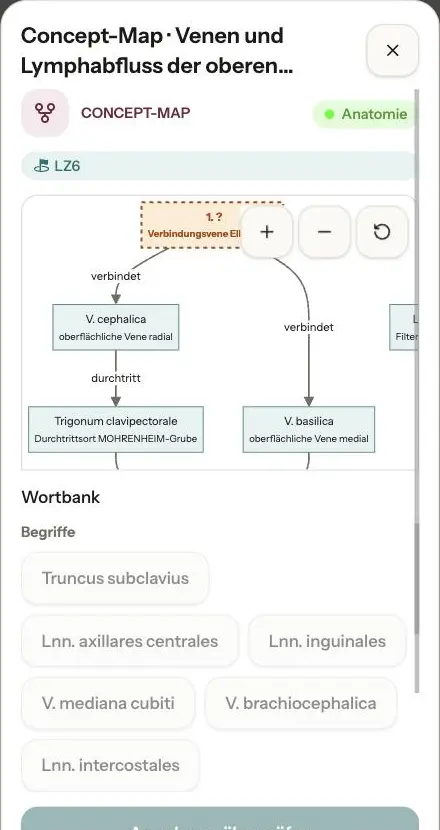
The AI turns your slides and notes into flashcards, quizzes and practice exams. You have to solve them yourself. Learngine spreads the reviews out until your exam and shows you how confident you are in each topic.

Read more: Flashcards from lecture slides and Anki flashcards with AI.

Frequently asked questions
How many flashcards per lecture?
As many as there are exam-relevant facts and connections. Often that is 10 to 30. What matters more than the number is that each card has only one question.
Should I make my own flashcards or use ready-made ones?
Writing them yourself helps you understand, but takes time. Ready-made or AI-generated cards save time. Read them once critically and change what doesn't fit.
How often should I review flashcards?
With growing gaps: on the first day, after a few days, after a week, shortly before the exam. Cards you didn't know come back sooner.
Show sources (3)
- Kornell, N. (2009): Optimising learning using flashcards: Spacing is more effective than cramming. Applied Cognitive Psychology, 23(9), 1297–1317. Article
- Roediger, H. L. & Karpicke, J. D. (2006): Test-Enhanced Learning: Taking Memory Tests Improves Long-Term Retention. Psychological Science, 17(3), 249–255. PubMed
- Dunlosky, J. et al. (2013): Improving Students' Learning With Effective Learning Techniques. Psychological Science in the Public Interest, 14(1), 4–58. PubMed