
IN SHORT
Active recall means retrieving knowledge from memory instead of reading it again. You ask yourself a question, answer without looking at your notes, and only check afterwards. It is harder than reading, but you remember much more. Flashcards, quizzes and practice exams are the easiest ways to do it.
Key takeaways

What active recall is
When you read, you recognise material. When you retrieve, you have to produce it yourself. That act of producing it is what makes the knowledge stick. In research this is called the testing effect or retrieval practice.
Rereading your notes
Ask a question and answer from memory
Highlighting key points
Blank page: write down everything you know
Copying a summary
Flashcard: question on the front, answer on the back
Looking at the solution
Solve the problem first, then compare
What the research shows
In a well-known experiment, students read a text. Some read it again, others wrote down what they could remember without looking. A week later, the second group remembered considerably more (Roediger and Karpicke, 2006).
Retrieval also beats a popular alternative: in one experiment, retrieval practice did better a week later than creating concept maps (Karpicke and Blunt, 2011). A large review rates practice testing as one of the most effective study techniques. Rereading and highlighting rank far lower (Dunlosky and colleagues, 2013).
How to use active recall
- 1Questions instead of notes.
Write two to three questions for each slide. Keep the answers somewhere else.
- 2Answer first.
Say or write the answer before you check. An attempt counts too.
- 3Check honestly.
Compare with your notes. Anything wrong or half right comes back soon.
- 4Blank page.
After a lecture, spend ten minutes writing down everything you know. Then fill the gaps.
- 5Repeat with gaps.
The same questions again after a few days. That combines active recall with spaced repetition.
The most common mistakes
How Learngine does it
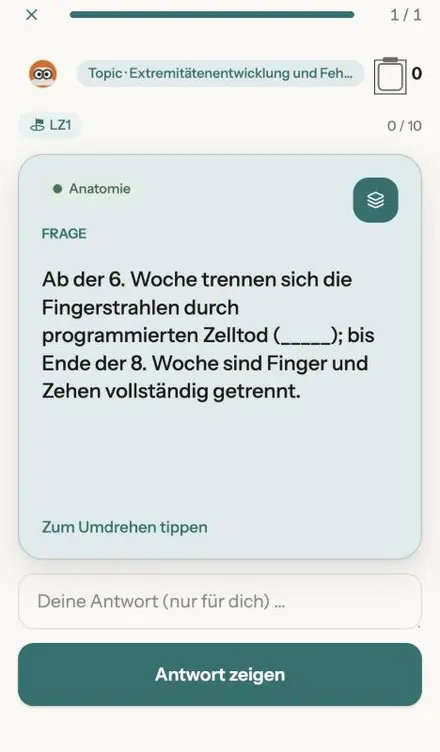
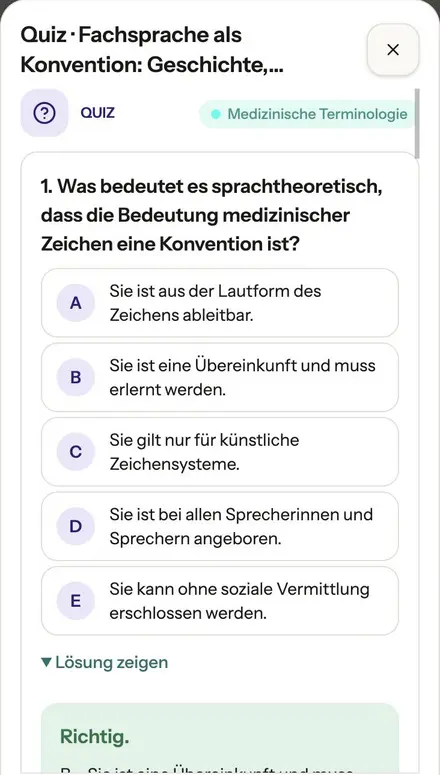
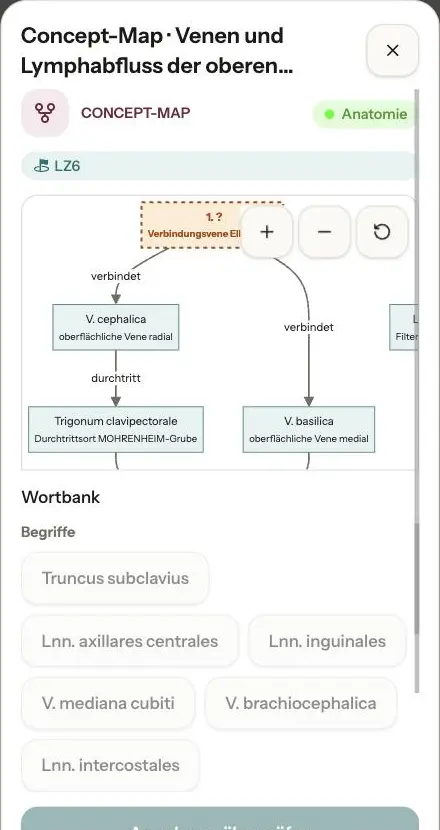
The AI turns your slides and notes into flashcards, quizzes and practice exams. You have to solve them yourself, because that is what counts. Learngine shows you how many exercises you have done and how confident you are in each topic.


Frequently asked questions
What is the difference between active recall and spaced repetition?
Active recall is how you review: by retrieving. Spaced repetition is when: with growing gaps. They work best together.
Does active recall work for maths and other problem-based subjects?
Yes. There, retrieving means working problems without the solution and only comparing afterwards. Mixing problem types helps as well.
How much time should I spend on retrieval?
More than on reading. A good rule of thumb: once you have understood the material, spend most of your study time on questions and problems.
Show sources (4)
- Roediger, H. L. & Karpicke, J. D. (2006): Test-Enhanced Learning: Taking Memory Tests Improves Long-Term Retention. Psychological Science, 17(3), 249–255. PubMed
- Karpicke, J. D. & Blunt, J. R. (2011): Retrieval Practice Produces More Learning than Elaborative Studying with Concept Mapping. Science, 331(6018), 772–775. PubMed
- Dunlosky, J. et al. (2013): Improving Students' Learning With Effective Learning Techniques. Psychological Science in the Public Interest, 14(1), 4–58. PubMed
- Carpenter, S. K., Pan, S. C. & Butler, A. C. (2022): The science of effective learning with spacing and retrieval practice. Nature Reviews Psychology, 1, 496–511. Article